

The Last Time Mexico Opened a World Cup, the World Was a Completely Different Place.

Forty years.
That's how long it's been since Mexico last stood at the center of the football universe — sleeves rolled up, stadiums packed, and the whole world watching.

In 1986, El Tri didn't just host a tournament. They hosted an era.
Mexico became the first nation to organize two World Cups, welcoming 24 national teams across 12 stadiums. But to understand what that moment meant, you have to understand the world that walked through those stadium gates.
The Berlin Wall was still standing. Mikhail Gorbachev had only recently introduced Glasnost and Perestroika, and while winds of change were starting to blow, the U.S. and Soviet Union remained locked in one of the tensest periods of the Cold War. Reagan and Gorbachev would meet in Reykjavik later that October to discuss nuclear disarmament, a summit that felt unthinkable just years before.

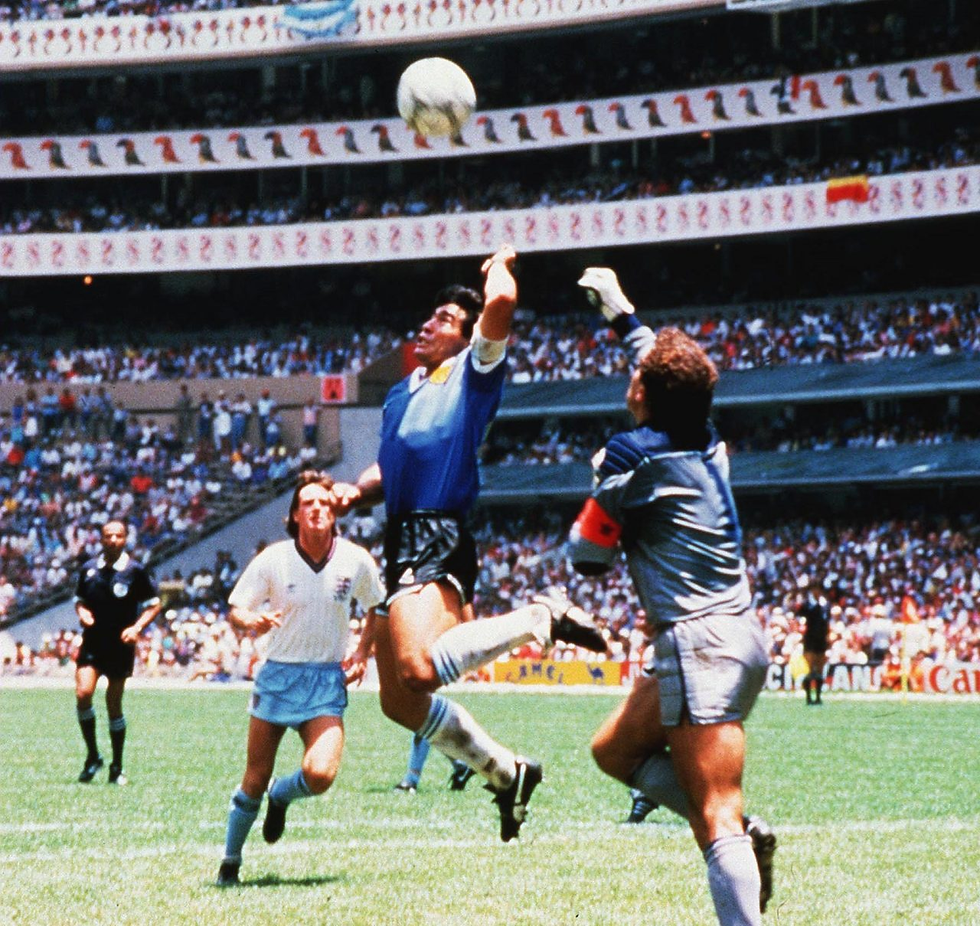
The Argentina-England quarterfinal carried political undertones that went far beyond football — it came in the shadow of the Falklands War, adding a layer of tension and meaning that no preview sheet could capture. This wasn't just sport. It was geopolitics on grass.
Just weeks before the first ball was kicked at Mexico '86, one of four nuclear reactors at the Chernobyl power station exploded on April 25, 1986 — releasing radioactive particles across Russia and surrounding countries in what remains the single biggest nuclear accident in history.

Football became an exhale. A reason to look at something other than the sky.
The internet did not yet exist for the general public. Google would not be founded for more than a decade. Facebook was still 18 years away. The first iPhone would not arrive for another 21 years. Advances in broadcasting meant the World Cup reached a truly global audience with improved production quality for the first time — and the images of Maradona weaving through defenders were seen by millions worldwide, embedding the tournament in collective memory in a way earlier editions could not match.
You watched it when it aired. You felt it because you had no other choice.
The biggest movie in the world was Top Gun, which made Tom Cruise a global name. Paul Simon released Graceland, an album rooted in African music that became a worldwide phenomenon. The synth-pop was loud. The shoulder pads were wide. And somewhere between Kenny Loggins and a jalapeño in a sombrero, football became the world's great equalizer.
That jalapeño — named Pique — was the official mascot of Mexico '86, wearing a sombrero and a Mexico jersey, a playful nod to Mexican cuisine and identity. It remains one of the most beloved World Cup mascots in history. Pure culture, no algorithm required.
And then there was Maradona, he delivered one of the greatest individual performances in World Cup history — scoring 5 goals and providing 5 assists, including the infamous "Hand of God" and the "Goal of the Century," a solo run past five England players that no one who saw it has ever fully recovered from.
Four decades later, the 1986 World Cup endures not just because of nostalgia, but because it represents a kind of ideal: a transcendent star at his peak, a variety of great teams playing great soccer, dramatic storylines, and a global audience ready to embrace it all. Every tournament since has been measured, in some way, against Mexico '86.
Here's the part that doesn't get said enough: in September 1985 — just eight months before the tournament — a major earthquake struck Mexico City, killing more than 5,000 people and causing enormous economic damage. A country still mourning. A city still rebuilding. And yet Mexico hosted the world Cup, because in one way or another they knew the world needed this moment among the chaos.

Despite the disasters, The stadiums were filled with waves of cheers, colorful displays, and the unmistakable sound of the Mexican wave — making it an unforgettable experience for players and spectators alike.
That's not resilience as a talking point. That's La Afición as a way of life.
For the US and Canada, hosting this World Cup means growing the sport. A mission that both nations have embarked on since 1994 that "gave birth" to the now successful Major League Soccer that consists of US and Canada Teams. For Mexico, it's about regaining their edge in World Futbol.
This 2026 edition will set a new record, as Mexico becomes the first nation to host matches in three different World Cups further cementing its unique legacy in FIFA history.
Bienvenidos. Again. Welcome back.


Comments